
Sometimes, great projects begin not with professional ambition, but with a deeply personal question. For Marina Vasylieva, founder of YEDYNA, that question was about the future of her own children.
A few years ago, as they began to grow up and think about where to study, who they wanted to become, and what path they might choose in life, Marina looked at her own professional journey from a different perspective for the first time. More than twenty years of her life had been devoted to the bridal industry. But would she one day be able to explain to her children why this was a legacy worth continuing?
“I asked myself a very simple question: if I want my children to one day continue the work to which I have devoted more than twenty years of my life, will I be able to explain them why? Why wedding dresses? What is so valuable about this work that it is worth dedicating a lifetime to?”
The search for an answer to this question became the beginning of “Ukrainian Wedding Wonder”.
At first, Marina thought she was going to explore the history of the wedding dress. But the deeper she immersed herself in the subject, the clearer it became: it is impossible to understand the dress without first understanding the meaning of the wedding itself.
Weddings existed long before the emergence of the modern fashion industry. For thousands of years, states, borders, societies, religious traditions, and cultural systems have changed, yet people have continued to create families and give this moment a special significance. Wedding traditions have preserved a people’s ideas about family, beauty, prosperity, belonging, and continuity between generations. And the image of the bride has become one of the most revealing reflections of its time.
“At some point, I realized: if you want to understand a people, look at how they celebrate a wedding and how they dress their bride.”
&This thought led Marina to see the Ukrainian wedding dress in an entirely new way.
She witnessed firsthand the formation of the modern Ukrainian bridal industry: how small workshops grew into production companies, how Ukrainian dresses began to be sold far beyond the country’s borders, how brides from different countries travelled to Khmelnytskyi to find their wedding dresses, and how thousands of gowns were shipped from Ukraine every day across the former Soviet Union.
Over time, Ukrainian brands entered the international market. Today, their collections are presented at professional trade shows and in bridal salons across dozens of countries, while dresses created in Ukraine are chosen by brides around the world.
Marina witnessed this transformation from within. But the greater the international success of Ukrainian bridal fashion became, the more another question occupied her mind: why Ukraine?
Why did Podillia and Bukovyna become the regions where communities of artisans, dressmakers, and entrepreneurs developed over decades? Where did the knowledge and skills that would later become the foundation of large-scale production come from? Who were the people with whom this story truly began?
This was how a personal question grew into an extensive research project.
Marina began meeting the people who stood at the origins of the industry: seamstresses, pattern makers, entrepreneurs, founders of production companies, and entire families in which the skills of sewing, embroidery, and creating bridal decorations had been passed down from generation to generation.
Some conversations did not happen on the first attempt. Marina returned to certain women several times, asking them to share their memories of the past — only to be met with refusal.
“I couldn’t understand why they didn’t want to talk. So many years had passed. The country had changed, the laws had changed. And then I realized: the fear remained.”
During the Soviet era, private work and trade could have serious consequences. Women created garments at home without having the legal means to sell them. They hid their work, fearing denunciation and punishment for so-called “speculation”. Even decades later, some of them found it difficult to speak openly about what today we would simply call craftsmanship and entrepreneurship.
These conversations gave Marina a sense of urgency: these stories needed to be recorded now, while the people who remembered them not from documents, but from their own lives, were still here to tell them.
Gradually, stories began to emerge that could never be found in a conventional chronology of fashion.
There was the story of a man who returned from a concentration camp after the Second World War with a woman who was an artist. She began drawing and making decorative flowers, formed a small group, and taught the craft to women in the local community. Over time, these flowers became a distinctive feature of weddings throughout the region.
There were stories of women who embroidered veils and hid them in straw so that no one would discover their work and report them to the authorities.
Of men who spent their nights making flowers for bridal wreaths.
Of children who sold decorations made by their families at local markets because adults risked punishment for private trade.
Behind each of these stories was far more than a wedding accessory. There was ingenuity, labor, the need to survive, family knowledge, and craftsmanship passed down even through the most difficult historical circumstances.
“The more I listened to these people, the more I understood: what I was discovering was not the history of wedding dress production. It was the history of Ukraine.”
And with that realization, the scope of the future book changed as well.
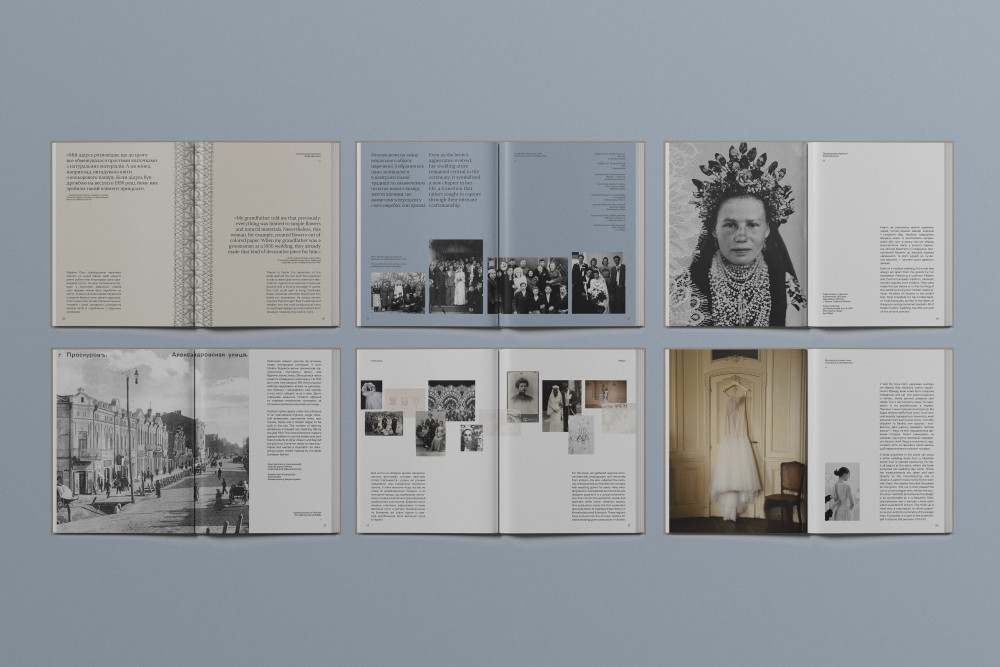
“Ukrainian Wedding Wonder” began to take shape through personal testimonies, archival photographs of brides from different regions of Ukraine, family albums, museum materials, historical documents, the memories of artisans, and conversations with people who had established their first workshops more than thirty and even forty years ago.
Photography became an especially important part of this story. These images reveal much more than the evolution of the wedding dress. Through changing silhouettes, fabrics, embellishments, hairstyles, and bridal looks, they allow us to trace the transformation of Ukraine itself — its aesthetics and its evolving ideas of beauty.
Gradually, the history of the Ukrainian wedding dress began to emerge: from the local craftsmanship of Podillia and Bukovyna, the first sewing machines and home workshops, to large-scale production and internationally recognized brands.
For Marina, this history is inseparable from YEDYNA — the brand through which she herself has been part of the Ukrainian bridal industry for more than two decades. By exploring the past, she was also searching for an answer to a question about the origins of the work to which she had devoted her own life.
“Ukrainian Wedding Wonder” became an attempt to preserve that answer.
Not only for her own children. For the next generation of designers, artisans, and entrepreneurs. For Ukrainians shaping bridal fashion today. And for the world, which has long known Ukrainian wedding dresses, but knows far less about the people and stories behind them.
Today, the words “Made in Ukraine” on a wedding dress can tell us far more than simply where it was produced. Behind them are specific regions, families, generations of artisans, decades of handcraftsmanship, entrepreneurial courage, and cultural memory.
And perhaps it was here that Marina Vasylieva finally found the answer to that first, deeply personal question.
Why is this work worth dedicating a lifetime to?
Because it has long been about more than creating dresses. It is a story of people, families, and craftsmanship passed from one generation to the next. And it is part of Ukrainian history — one that deserves to be preserved and passed on.